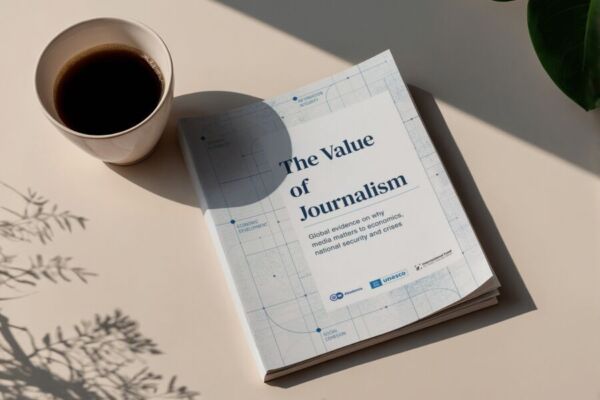
The report was commissioned by UNESCO, the International Fund for Public Interest Media (IFPIM), and DW Akademie, working as members of the Research Working Group of the Media Viability Manifesto initiative, of which GFMD is a founding member. It was authored by Professor Mel Bunce and Dr Beth Pearson of City St George’s, University of London.
GFMD’s Deputy Director Tom Law, who moderated the launch session, called it “a timely and valuable contribution”, and the numbers in the report make clear why. The session, titled The Value of Journalism: Why Media Matters to Economics, National Security and Crises, was held during the DW Global Media Forum and brought together speakers Mel Bunce (City St George’s, University of London), Martin Hoppe (BMZ), and Anya Schiffrin (Columbia SIPA), with reflections from Kate McGeown (FCDO).
The evidence in brief
The report synthesises the latest academic research to build a powerful, data-driven case for sustained investment in independent journalism. Its headline findings span economics, security, and humanitarian response:
Economic impact
- A study of 97 countries found that declining press freedom is associated with a 1–2% reduction in real GDP growth and that the damage is slow to recover.
- Every $1 invested in journalism can generate more than $100 in public savings through reclaimed funds, improved public services, and reduced corruption.
Disinformation and security
- Disinformation costs societies an estimated $355–516 billion each year. Independent journalism is among the most effective and evidence-based tools to counter it.
- In 2026, the World Economic Forum ranked disinformation as the second most pressing global risk.
- Experts estimate that just 0.1% of global GDP — equivalent to 15 days of global military spending — could fund healthy public media and secure information environments for citizens everywhere.
Human rights and conflict
- A study of 152 countries found that greater access to free media is associated with a reduction in human rights abuses and a lower likelihood of conflict and repression.
- News coverage also directly shapes humanitarian response: a study of more than 2,300 disasters found that every additional story in the New York Times generated an additional $500,000 in official emergency aid.

Launch of the report at DW Global Media Forum, 23 June 2026. From left to right: Mel Bunce (City St George’s, University of London), Martin Hoppe (BMZ), Tom Law (GFMD). Source: dw.akademie.com
A moment of acute urgency
The report arrives at what its authors describe as the most precarious moment for independent journalism in recent history. The recently published 2026 RSF World Press Freedom Index shows that only 1% of the world’s population now lives in countries where press freedom is rated as “good”, and that for the first time in the index’s 25-year history, more than half of all countries fall into the two lowest categories.
UNESCO’s World Trends in Freedom of Expression and Media Development Report 2022–2025 found that freedom of expression has declined by 10% worldwide since 2012, a level not seen in decades.
Meanwhile, public funding for media is declining, drastic cuts to international aid and media development budgets continue, and social media platforms and AI are accelerating the erosion of traditional revenue streams. Audiences worldwide are losing access to trusted, independent sources of news.
Against this backdrop, The Value of Journalism provides the evidence base for what the media development sector has long argued: that investment in independent journalism is not a cost — it is a return.
A shared framework for action
The Value of Journalism is one product of the Media Viability Manifesto‘s Research Working Group, which brings together UNESCO, DW Akademie, IFPIM, GFMD, BBC Media Action, Free Press Unlimited, Fondation Hirondelle, Forum for Information and Democracy, RNW Media, International Media Support, and Thomson Reuters Foundation.
The report also highlights the need for continued investment in research from Global South contexts: a gap that the Manifesto initiative is committed to addressing.