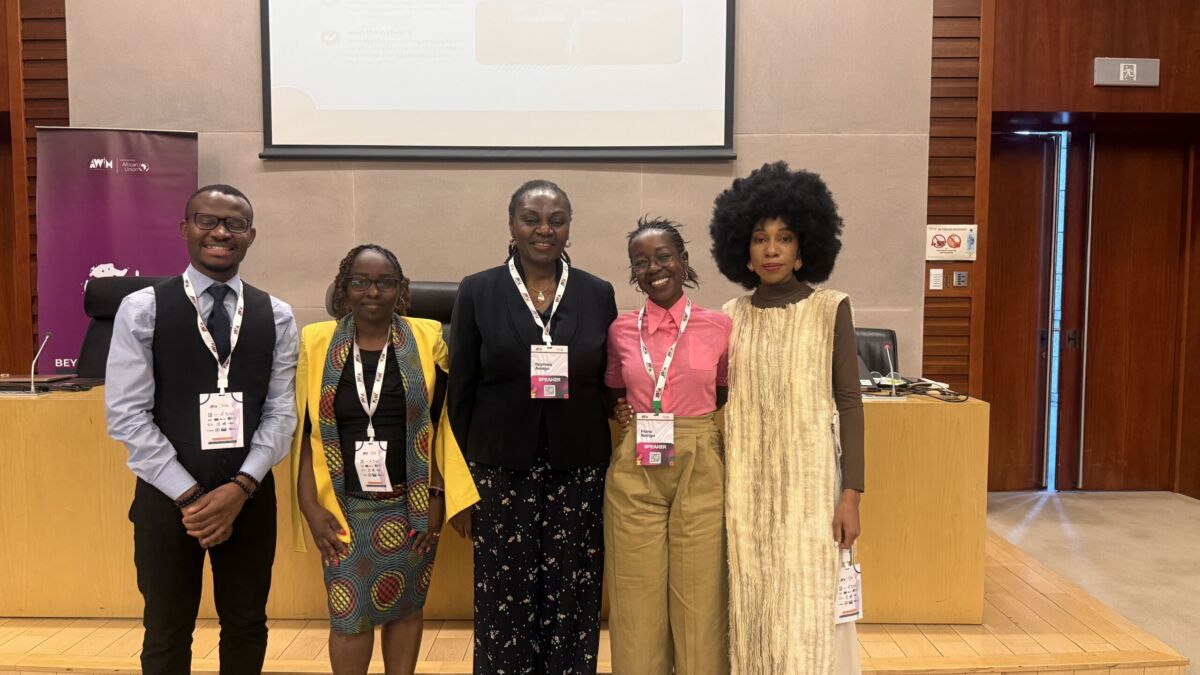
One of the first-day panels focused on Media Narratives and Policies that Shape Online and Offline Violence against Women in Media. GFMD’s Membership and Engagement Manager, Fiona Nzingo, joined Dr Vincent Obia of University of Sheffield, independent journalist and Red Ribbon Award winner Stella Kasina, and Mantate Queeneth Mlotshwa, founder of First Today Africa. The panel was moderated by Ifeyinwa Awagu, researcher and Humanities Director at Pan-Atlantic University in Lagos. The discussion examined how harmful narratives, institutional failures and weak accountability mechanisms contribute to the normalisation of violence against women journalists and what can be done to reverse this trend.
Giving shape to violence
Fiona Nzingo outlined a three-step process through which violence against women journalists becomes normalised.
Step one: Normalising harm
Online attacks against women journalists are disturbingly common. According to WAN-IFRA, 48% of women journalists have received sexist insults, and 18% have received rape threats. Beyond their personal toll, such attacks create a culture in which degrading and threatening language becomes routine.
Mantate Queeneth Mlotshwa noted that harassment frequently relies on sexualised and gender-specific insults designed to objectify women journalists and silence them. Intersectional discrimination further intensifies this abuse. A UNESCO report shows that 85% of Black and Arab women journalists have experienced digital harassment.
Dr Vincent Obia arguedd that social media platforms have exacerbated the issue for African journalists in particular:
“These social media platforms are headquartered outside Africa and likely have only a passing interest in issues of the harassment of women and girls in Africa. And to make matters worse, the government in Africa may struggle to extend regulatory powers to platforms, at least to the same degree that Western governments can manage.”
He described this dynamic as the “politics of locationality.” By failing to invest in adequate translation services and better cultural understanding of the harassment of women on the continent, these companies have allowed a misogynist culture to flourish on the African side of their platforms.
Step two: When systems fail
Despite the prevalence of harassment, media institutions often lack robust internal protections. Nzingo described a persistent policy vacuum:
“You see that this is a policy vacuum, and combined with effective social media platform tools, it creates an environment of impunity for perpetrators. (…) Only a quarter of workspaces have adequate policies. This is a failure that leads to tangible professional consequences.”
As a result, two-thirds of women journalists have not reported their harassment, with 85% feeling like adequate action is not taken in cases where abuses are reported to the company. Eventually, the underreporting of harassment leads perpetrators to feel they are safe from prosecution and accountability. The result is not only personal harm but professional damage — including stalled careers, withdrawal from public-facing reporting, and diminished newsroom diversity.
Step three: From screen to street
In some cases, the threats made towards women journalists do not stay confined to the digital realm. Around 20% percent of women journalists have experienced physical attacks linked to online harassment. Violence of this kind has an insidious effect on the entire media landscape – when journalists feel at risk, they are oftentimes forced into a state of self-censorship.
In one in five cases, women journalists have left the profession due to safety concerns. The cumulative effect is a narrowing of perspectives in the media landscape and a loss of gender diversity in public discourse.
Working towards a safer future
The panel moved beyond diagnosis to propose practical interventions across institutional, cultural and individual levels.
- Creating policy with impact: Responsibility for addressing harassment needs to shift away from the personal level and towards the institutional. Media companies need comprehensive gender-sensitive safety policies, clear reporting mechanisms, and transparent accountability processes to protect their employees. This could be incentivised by funders requiring their partners to work on their internal policy. As Nzingo emphasised:
“Narrative shapes behaviour, policy shapes accountability. Narratives and policies define our safety to protect women journalists; we must change both.”
- Transforming company culture: Gender narratives within media institutions may need to shift on a broader level. Through holistic safety training, psychosocial support and editorial audits to identify internal biases, companies could manifest a cultural shift to the benefit of their women journalists.
- Transforming digital culture: On the individual level, one can challenge the misogyny of online spaces by responding to degrading or threatening comments aimed at women journalists. Speakers identified three strategies for responding to online harassment: the moral appeal, which calls on the harasser’s ethics; the legal response, which reminds the harasser that their words could have legal consequences; and the unity-focused response, which redirects hostility toward constructive dialogue. Mlotshwa underlined the broader significance of such responses:
“[These] responses are not just defending individuals; they’re also challenging the norms and establishing what should be acceptable as the language aligns. So it’s pushing back on this misogynistic language that is this problematic thing in our societies.”
- Documenting evidence and strengthening accountability: Challenging perpetrator impunity requires better accountability mechanisms. If threatening language is documented consistently and professionally, the targeted journalist will have a much better chance at receiving justice via the legal route. Independent monitoring bodies and improved reporting systems can help collect and preserve evidence, reducing impunity and strengthening advocacy efforts.
- Moving from frameworks to funding: Lastly, panellists stressed that commitments must be backed by resources. Stella Kasina called for tangible support rather than symbolic declarations:
“Stop uploading the frameworks. Start resourcing the journalists who are actually activating them, fund them. Do it before 2030 and the Kigali declaration becomes a reality. Do it after, and it becomes another expensive gravestone.”
Independent journalism organisations in Africa often operate without sufficient legal aid, financial backing, or trauma support while covering politically sensitive issues. Protecting women journalists requires sustained investment and meaningful partnerships.
A Collective responsibility
The discussion concluded with a call for coordinated action across governments, media organisations, tech platforms, funders and civil society. Enforceable policies, accountability mechanisms and cross-sector cooperation are essential to reversing the normalisation of violence against women in media.
Ensuring the safety of women journalists — online and offline — is not only a matter of individual protection. It is fundamental to media freedom, diversity and democratic participation across the continent.