Africa Editors’ Congress (23–24 February)
On the opening day, Zoe Titus and Catherine Gicheru each moderated a panel discussion, while Fiona Nzingo presented key findings from GFMD’s latest report, Mapping of Media Assistance and Journalism Support Programmes in Sub-Saharan Africa, and led an interactive workshop on rethinking the funding mix for resilient media in Africa.
Building trust in the media
The panel “Building trust in the media: information integrity and media regulation” on February 23, moderated by Zoe Titus, explored how to build trust in the media through information integrity and media regulation. Titus was joined by Dr Phathiswa Magopeni (Press Council of South Africa), Dr Taryn De Vega (Rhodes University’s School of Journalism and Media Studies), and John Okande (UNESCO).
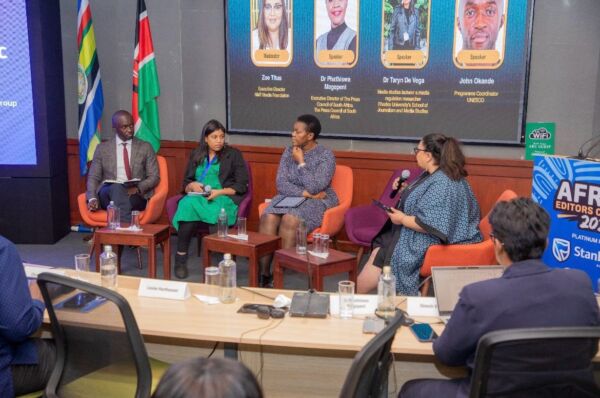
From left to right: John Okande, Dr Taryn De Vega, Dr Phathiswa Magopeni and Zoe Titus
The discussion examined how African media systems are responding to declining public trust, coordinated disinformation, and the growing influence of digital platforms. Speakers agreed that trust is closely tied to accountability, effective self-regulation, and information integrity in an era shaped by big tech.
- Accountability and Self-regulation: Dr Magopeni highlighted how trust is often affected by overlooked practices, such as the right to reply, and advocated using Press Codes as active training tools — not just in newsrooms, but in journalism schools. The panel strongly favoured voluntary, media-led self-regulation over statutory regulation, with Dr De Vega pointing to the Voluntary Media Council of Zimbabwe (VMCZ) as a working example.
“We have to have editors and journalists agreeing to the system, participating in drawing up codes of conduct and then voluntarily being willing to agree to the sanctions of those particular councils. If it feels like it’s external, the media has probably not really participated in that process. We want media participation and public participation, because, again, the public is not just about “are we serving the public interest?” but “are the public actively engaged?” noted Dr Taryn De Vega.
- Digital platforms and information integrity: John Okande emphasised that information integrity is now a multi-dimensional issue spanning human rights, democracy, and safety. He warned against reactive, restrictive lawmaking and called for sustained, forward-looking policy approaches that address jurisdictional gaps between platforms and existing legal frameworks. The panel concluded with a call for editors and media owners to engage more actively in policy spaces and take responsibility for ethical standards.
AI adoption and editorial independence
Catherine Gicheru moderated a discussion on AI and editorial independence with Daniel Kalinaki (Uganda Editors Guild, National Media Group (Uganda) and Christine Mungai (The Continent). Speakers broadly welcomed AI for workflow support: monitoring social media, analysing speeches, translation, archiving, and quality control — while firmly agreeing that AI must not replace editorial judgment, reporting, or verification.
- Where AI adds value: Mungai highlighted how tools like Google’s NotebookLM can improve archive searchability and identify coverage gaps, and noted AI’s usefulness in drafting donor proposals. Kalinaki encouraged organisations to think beyond the newsroom and adopt AI at an enterprise level — for example, analysing legacy audiences to support digital transition.
- Risks and red lines: Speakers raised concerns about over-reliance on AI, including reporters outsourcing core journalistic tasks. Clear boundaries were set: AI should not generate story ideas, replace editorial judgment, fabricate quotes, or simulate reporting.
“If we give up our news gathering, our writing, our editing, our content production, then we lose our premium in a world where the majority of data out there is actually AI-generated”, emphasised Christine Mungai.
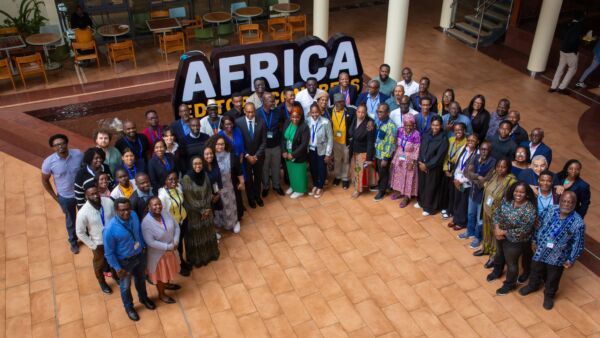
Africa Editors’ Congress 2026 participants
Africa Media Festival (25–26 February)
At the Africa Media Festival, focused on the future of journalism and creative expression in Africa, Catherine Gicheru opened Day 2 with a keynote address. AI and emerging technologies again dominated the agenda, with speakers examining how they influence audience engagement and ethics — including “digital censorship” embedded in platform algorithms and terms of service.
Key themes emerging from the Festival included:
- Redefining resilience: Resilience means actively creating alternative systems, communities, and funding models — not just surviving censorship or financial pressure.
- AI as a tool, not a replacement: AI can support workflows and investigative reporting, but human ethics, judgment, and contextual understanding remain essential.
- Owning the narrative: African stories must be authored locally, capturing indigenous knowledge and authentic perspectives rather than filtered through external lenses.
- Solidarity beyond borders: Press freedom anywhere is a responsibility everywhere; sessions highlighted long-silenced independent media, including in Eritrea.
- Sustainability and the creative economy: Speakers called for diversified funding through private sector partnerships and philanthropy, reducing dependency on traditional donor models.
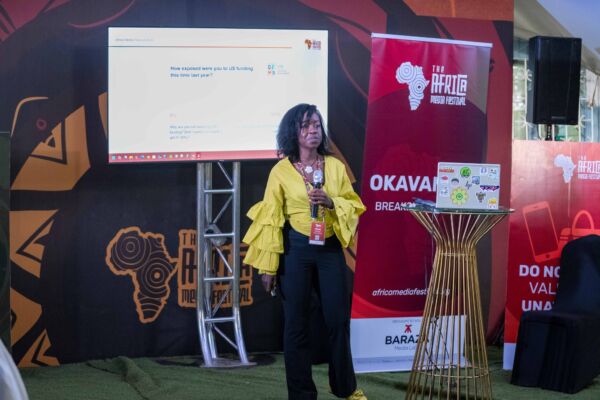
Fiona Nzingo leading a workshop at the Africa Media Festival
Fiona Nzingo also led an interactive workshop, “Beyond donors: Rethinking the funding mix for resilient media in Africa”, in which participants mapped their real-world funding landscapes — from ODA and philanthropy to technology platforms, private sector actors, and development banks. Drawing on the Mapping of Media Assistance and Journalism Support Programmes in Sub-Saharan Africa report, Nzingo reiterated key recommendations for a more sustainable media funding ecosystem:
- Greater investment in core, multi-year, and risk-tolerant funding
- Stronger regional mechanisms and more programmes led by African organisations
- Strategic alignment around digital rights, platform governance, AI, journalist safety, and sustainability
- Improved transparency and reporting from bilateral and philanthropic funders
- Integrated media support within broader governance, peacebuilding, climate, and development agendas.
Taken together, the discussions in Nairobi point to a strategic shift from passive, donor-dependent models toward local ecosystem resilience and sustainable, independent journalism. Speakers highlighted funding power asymmetries, cautioned that digital transformation must keep AI in service of — not in place of — human editorial judgment, and urged the building of media ecosystems capable of withstanding political, economic, and technological pressures.