Commercially viable journalism
Media in Latin America and the Caribbean is adapting to the new funding reality, with many outlets experimenting with diversified streams of revenue. As GFMD’s mapping of official development assistance (ODA) for media in Latin America and the Caribbean, 2022–2026 shows, USAID cuts have presented a significant challenge to Media outlets in the region. Furthermore, Venezuela, Cuba and Nicaragua absorb 87% of the $170 million committed by donors to media in the region (of which US$165 million has already been disbursed).
As economic support dried up, so did political protection. In El Salvador, the government revived a foreign-agents law and issued arrest warrants against journalists; roughly 53 journalists went into exile in early 2025.
Even where funding exists, journalists have to make major adjustments to their approach. As one participant put it:
“It can take five separate small grants just to cover a single staff salary.”
Put in perspective, the US170 million mapped for the whole region is small next to the US135–140 billion funding available annually on the global level that public media, commercial publishers and the creator economy. GFMD’s 2026–2030 General Strategy offers a benchmark for the scale: directing 3% of combined public-service and publisher revenues towards independent accountability journalism would generate about €1.35 billion a year in Europe alone, and around €5 billion globally, an order of magnitude more than current aid-based funding. It is not a prediction, but it shows where lasting financial power already sits. That is why so much of the conversation at Gabo turned to solutions that don’t depend on a single new donor.
Several organisations are already testing what commercially viable journalism looks like in practice:
- MDIF invests debt or equity into outlets building genuine commercial revenue, then pairs the capital with free, ongoing advisory support for the life of the relationship. Its 160+ clients span more than 50 countries, a dozen or so of them in Latin America.
- SembraMedia and BBC Media Action, through the EU-funded Brave Media consortium, are piloting “SembraAnunciante” with outlets in Ecuador and Colombia, pairing training with a technology partnership to help them grow advertising revenue, rather than funding them directly. A parallel pilot with the Samir Kassir Foundation is testing a different model in Lebanon and Jordan, with lessons meant to travel between regions.
- Alharaca, after a two-year process funded partly by writing “sustainability strategy” work directly into its own grant applications, built a Europe-based venture arm selling ticketed live events (including a non-fiction escape room) and paid workshops, to cross-subsidise its Central American journalism. Its advice to the room: build that time and budget into grant proposals from the start, since donors have their own interest in organisations eventually needing less support.
- Smaller-scale examples surfaced too: a digital outlet in Mar del Plata, Argentina built a drone-video and content agency for local businesses; several MDIF-backed outlets run a café, an event space, or a travel agency alongside their journalism.
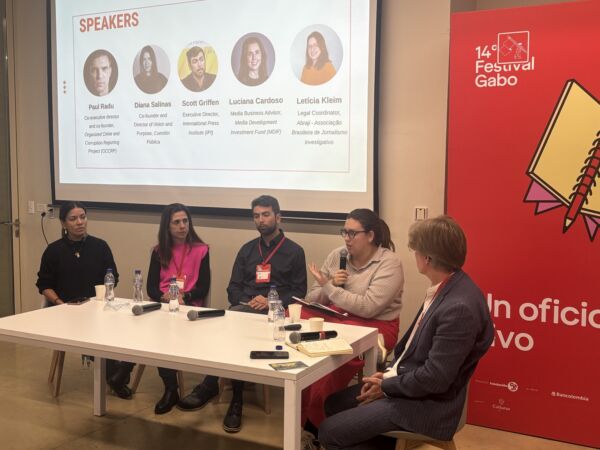
From left to right: Diana Salinas (Cuestión Pública), Luciana Cardoso (Media Development Investment Fund), Scott Griffin (International Press Institute), Leticia Klein (Abraji), and Paul Radu (OCCRP)
Turning the archive into a product
Participants argued journalism has to be treated “as a product” to survive commercially without losing its public-interest purpose:
“Journalism has to be seen as a product. Of course it contributes to democracy, to freedom of expression, to having an information society. But to be able to survive, those of us on this side have to treat it in a way that allows us to keep surviving.” – Diana Salinas, Cuestión Pública
For this purpose, Cuestión Pública built Odin, a RAG-based AI tool that draws on its archive of 7,000+ investigations and generates on-brand social content in about 30 seconds. It isn’t a paywall: investigations stay fully open to the public for a set period, then the underlying structured data, not the article itself, is “auto-recycled” into a searchable layer available by paid consultation. Odin needed a full rebuild once general-purpose tools like ChatGPT arrived; the newest version, Odin 4.0, took about two months, largely because the archive was already organised.
OCCRP is applying the same logic at a larger scale. Flatline, built with Fundación Gabo, is converting investigative-journalism IP into fiction films, twelve projects, two already advanced with Hollywood and European studio partners, and, more recently, commercial video games, with a first title aimed at the roughly $8 billion indie-games market slated for around February 2027.
Chequeado has taken a similar approach with its own tools: the Chequeado Transcriber moved from free to freemium (its paid tier adds simultaneous translation) and now has 200,000+ registered users, on track to cover roughly 10% of the outlet’s budget; Nunchi, an IPI-supported tool, monitors around 2,000 audience comments a week to flag when a fact-check or correction is needed. Both, participants noted, are exposed to rising AI-token costs as subsidised big-tech pricing fades. IPI made the underlying case for all of this: journalism as a product needs impact and reach, “otherwise it will just sit in a vacuum”, which is why IPI runs its Global AI Innovation Program for newsrooms in the global majority.
Sharing the cloud
For years, OCCRP carried the cost of investigative-computing infrastructure largely alone: an estimated $300,000–400,000 a year to Google Cloud, on top of $200,000–250,000 a year in engineering talent, just to serve a network of roughly 75 partner organisations. Paul Radu, OCCRP’s co-founder, described where that left them:
“These are not the choices journalists should have to make in 2025 or 2026: should we investigate this leak from Paraguay, or this one from Ghana? We should be able to work with the data available to us. But realistically, we can’t.”
The risk isn’t only financial. Radu pointed to the International Criminal Court’s own experience, and to European fact-checkers sanctioned by the US who lost the ability to operate bank accounts, as evidence that infrastructure controlled by outside governments or companies can turn hostile overnight.
Together with their members and partners, GFMD and OCCRP have responded to the call for shared infrastructure by creating the Journalism Cloud Alliance (JCA). The JCA provides cloud computing specifically for public interest initiatives by uniting public-interest organisations under one coalition. JCA now offers Infratype – hybrid-priced cloud infrastructure, subsidised for smaller organisations, positioned as cheaper than Google, Amazon or Microsoft Azure, running across multiple mid-tier ISPs (one, in Iceland, on thermal energy) with profits reinvested into investigative journalism. Longer term, the JCA wants to build a marketplace for journalism tools, license structured datasets to industries like due diligence, and adapt journalism-built AI tools for buyers outside the field.
Making legal defence collective
A participant from a Honduras-based outlet described a different kind of exposure: protecting not the published story, but the legal and administrative record behind it. With as little as three business days to answer right-of-reply and cease-and-desist letters, and no durable system for the case files behind each one, the outlet has been left searching manually through past cases under pressure. It has already lived the consequences: Meta removed 40 of its posts and took its Facebook and Instagram pages offline for about a week, apparently after coordinated mass-reporting for alleged copyright infringement, suspected to involve paid accounts organised through a Telegram group. Participants also pointed to El Faro‘s experience in Central America, where outlets are increasingly pressured through tax authorities rather than direct censorship, since a takedown request is far easier to obtain than a ban on content.
Abraji offered a working model in response: security audits, “chain of custody” practices for evidence, redundant storage across locations and people, restricted access, and a standing network of freedom-of-expression lawyers.
Abraji’s internal legal department, in place since the organisation’s founding, runs on dated follow-up templates for rights petitions, a pre-publication legal-review stage, and an archived “proof folder” for every published piece, so the evidentiary record survives even if the reporting journalist later leaves. It was offered as a model the JCA could absorb and run collectively. The discussion further highlighted Reporter Shield, a legal-protection scheme for investigative journalists. Radu concluded by expressing a vision to expand the Alliance into a comprehensive legal clinic that would also address data compliance issues.
Acting together
Some of the most concrete proposals were less about tools than about how the field organises itself:
- Share the overhead. Hires could potentially be pooled across outlets: one technologist, or one business-strategy lead, serving four or five organisations at once rather than each newsroom trying to build that capacity alone: “I believe that investing in infrastructure is entirely related to how we’re going to strengthen public debate, because I can’t view the two things as separate.” -Luciana Cardoso
- Share governance, not just tools. Participants discussed a 38-organisation global fact-checking coalition that took a full year just to agree on governance, data-sharing and revenue-sharing for a joint AI fact-checking tool: a slow process, but one made more urgent once OpenAI entered the same space.
- Engage banks and business on press-freedom terms. Private business, including banks, need to be engaged on press-freedom grounds specifically. Journalists need acknowledgement of how context-dependent these matters are from country to country, not to be folded into generic CSR or tax-break conversations.
- Make the economic case land with investors. Nordic investors weighing EU-accession-related investment in Ukraine are starting to see independent media’s anti-corruption reporting as directly relevant to their own risk exposure. This example could be used as a model of how to make the case for press freedom as a worthwhile investment.
Across both sessions, the throughline was the same: journalism’s funding problem won’t be solved by donors alone, and much of what’s needed already exists somewhere in the region: a blended-finance model here, a shared legal playbook there, an archive turned into a product a few countries over.
The work continues. Subscribe to the GFMD Insider for updates on the Journalism Cloud Alliance and GFMD’s other work building collective power and shared infrastructure for journalism.
GFMD ran two workshops on media funding and infrastructure at the 14th Gabo Festival in Bogotá, in collaboration with Fundación Gabo and the Organized Crime and Corruption Reporting Project (OCCRP), on 25 July 2026, as part of a festival that drew more than 18,000 attendees and 200 national and international guests. “How to Fund Tomorrow’s Journalism” was facilitated by GFMD’s Director of Policy and Insights, Ivana Bjelic Vucinic, and Advocacy and Policy Coordinator, Laura Becana Ball. “Technological Independence and Infrastructure for Journalism” featured a panel of experts: Paul Radu (OCCRP), Diana Salinas (Cuestión Pública), Scott Griffin (International Press Institute), Luciana Cardoso (Media Development Investment Fund), and Leticia Klein (Abraji).