Power, intermediaries and access
Regional Funding Ecosystems II: how media funding moves in Sub-Saharan Africa and the Middle East and North Africa.
| 2. October 2026
Regional Funding Ecosystems II: how media funding moves in Sub-Saharan Africa and the Middle East and North Africa.
| 2. October 2026
In February, we looked at how funding circulates in Latin America and the Caribbean, where regional foundations, intermediaries and diaspora networks do much of the work of getting money to newsrooms. This month we turn to Sub-Saharan Africa and the Middle East and North Africa (MENA). The same basic rule applies: very little money travels directly from a large donor to an individual outlet. What changes is who sits in the middle, how much power they hold, and how easy it is to get in.
If February was about noticing that intermediaries are the system, this issue is about noticing whose system it is.
Three features set both regions apart from Latin America. The table below puts them side by side: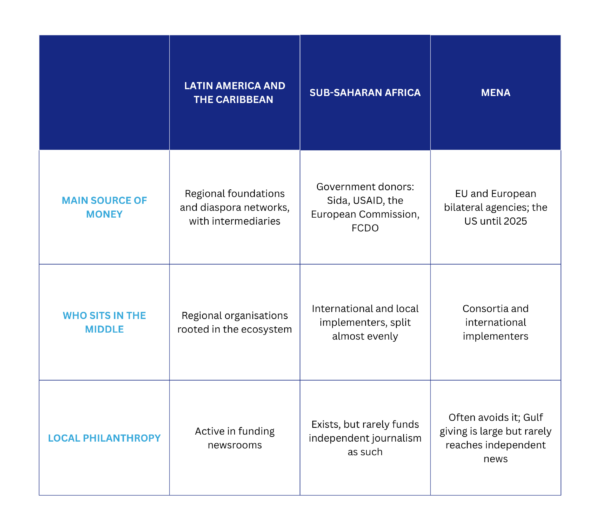
The result is an ecosystem where access depends less on finding the right open call and more on understanding who holds the relationship with the donor.
GFMD’s own mapping of media assistance in Sub-Saharan Africa, published in January, gives the clearest picture we have. Between 2020 and 2025, it found 326 programmes with USD 518 million in committed funding. Four government donors dominate: Sida (27%), USAID (26%), the European Commission (19%) and the UK’s FCDO (5%). Foundations are a small slice by comparison: MacArthur accounted for about 2% and Open Society/Luminate for under 1% (See GFMD’s Mapping of media assistance and journalism support programmes in Sub-Saharan Africa).
The money is also concentrated. Zambia, Nigeria and Mozambique together received more than 60% of all mapped funding, while Central Africa received 5%. For a newsroom in Central Africa, that means competing for a much thinner pool. And the form of support is narrow: 93% was grant-based, 67% project-based, and only 1% was core, flexible funding, even lower than the 4.1% GFMD found in Latin America.
MENA has no equivalent mapping yet, but the pattern is familiar. The evidence we do have points the same way as in Sub-Saharan Africa: The European Union, European bilateral agencies and, until 2025, the United States have been the main sources of support for independent media. Large calls illustrate how this works in practice. The European Commission’s media freedom grants for Syria, which closed in April, offered EUR 13.35 million across four lots of EUR 675,000 to 4 million, open only to consortia of organisations established in the EU, Syria, Lebanon, Türkiye, Iraq or Jordan. Money of that size reaches small newsrooms through partnerships, not direct applications.
Official aid works differently from the regional philanthropy we described in February. Even in Latin America, GFMD’s mapping found that 59% of committed media aid in 2022-2026 is implemented by organisations based in the donor country. In Sub-Saharan Africa, implementation is split almost evenly between local organisations (41%) and international ones (43%), with regional organisations managing only 4%. The rest is recorded as other (2%) or not available (8%). The report’s conclusion is blunt: Africa-led organisations continue to face structural barriers to large-scale, multi-year and flexible funding.
For a newsroom, that has three practical consequences:
This is not an argument against working with intermediaries. For most organisations they are still the realistic way in. It is an argument for choosing them deliberately, asking what share of a programme actually reaches local partners, and building relationships with more than one.
Pooled funds, where several donors combine money into one mechanism, are one response to that concentration of power. The International Fund for Public Interest Media (IFPIM) is the most visible example. Its December 2024 round awarded USD 5 million to 20 newsrooms across four regions, including Africa and the Middle East, as two-year flexible grants, and it aims to invest USD 150 million through 2028.
At a smaller scale, African-led regranting schemes are filling some gaps with modest, fast grants for reporting and innovation. The GFMD mapping still found intermediary funders and pooled mechanisms minimal overall, and its recommendations call for more of them, alongside more programmes managed by African-led organisations.
In MENA, the regional funding infrastructure is thinner still. Recent efforts to explore a regional fund for public-interest media were set aside because the current funding environment could not support one. That tells you something about how hard pooled models are to build without a committed donor base.
The United States’ withdrawal from media assistance in 2025 showed how exposed these ecosystems are to a single donor. USAID had accounted for roughly a quarter of mapped media funding in Sub-Saharan Africa. In the Levant and Iraq, USAID provided more than USD 5 million for media development between 2020 and 2024, plus USD 1.5 million from the State Department.
Other donors have not filled the gap. In a survey for the Carnegie Endowment, 48% of 177 respondents reported decreased support from other international donors in 2025, and only 21% reported an increase. The authors note that European donors, Sweden in particular, prioritised Ukraine, and that Open Society Foundations had already frozen most of its grantmaking to the sector in 2023. Sida is also the largest mapped donor in Sub-Saharan Africa (27%), so its priorities matter there. Research from SAIIA reaches the same conclusion for Africa: alternative funders are unwilling or unable to replace what USAID left behind.
The lesson for fundraising is structural. When one bilateral donor funds a quarter of an ecosystem, its exit removes whole programmes, and the intermediaries that ran them, not just individual grants. Diversification has to happen at the level of the ecosystem as well as the organisation.
Local and regional philanthropy is where both regions differ most from Latin America. It exists, but it seldom calls itself media funding.
In both regions, a growing share of independent journalism is produced from outside the country it covers.
Sudan: More than 500 Sudanese journalists have fled the country since the war began in April 2023, according to the Sudanese Journalists Syndicate, and they face legal restrictions and other pressures in exile. In a February 2026 GFMD case study, the director of Ayin Network said emergency funds and fellowships have helped journalists relocate, but that needs are far greater than the support available, and that fundraising for exiled journalists remains ad hoc and piecemeal.
Syria: Since the fall of the Assad government, the picture is mixed. As of February 2026, at least 20 Syrian outlets were operating in exile or in a hybrid model, with a presence inside and outside the country, and many have cautiously and partially re-entered or are considering it. Some, such as Syria TV, have moved their teams back to Damascus. A full return is held back by unfinished administrative regularisation, security risks and a funding crisis.
Exile changes the funding logic. Registration, banking and legal status in the host country often matter as much as editorial quality. Funders that work in this space tend to value flexibility: the European Endowment for Democracy, for example, directed about 19% of its MENA grants to Syrian partners between 2020 and 2024 and set up an emergency funding mechanism after the fall of the Assad government, later extended to partners hit by the US aid freeze.
Some of February’s advice applies here unchanged. Some needs adjusting: