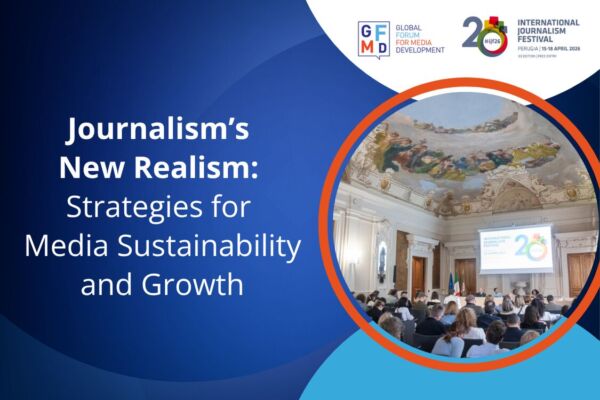
At the 20th edition of the International Journalism Festival (#ijf26), held in Perugia from 15–18 April 2026, sustainability and funding were at the very heart of the agenda. Across a series of panels, media practitioners and funders from around the world mapped both the damage and the way forward. We have gathered the key insights and actionable recommendations that emerged.
Author: GFMD Secretariat | 13. May 2026
Share:
The global journalism landscape is undergoing a systemic transformation driven by the collapse of traditional advertising and the withdrawal of institutional aid. To survive and ultimately to grow, independent media outlets are moving beyond mere subsistence toward what speakers at IJF26 called a “new realism“: a pragmatic, unsentimental approach characterised by audience-centric business models, shared infrastructure, and strategic private investment.
1. Reader revenue and community-led growth
The shift from advertising to reader revenue is now the core strategy for leading independent publications, and it is often born out of a moment of acute crisis when traditional models simply stopped working. Liz Win from The Guardian described how their reader-funding model, once it found its footing, accelerated far beyond anything a conventional membership programme could achieve:
“It rapidly outstripped our very nascent sort of membership business that we had at the time; it was all based around live events, it was tiny… success has many fathers and from then everyone bought into it.”
A central lesson from Perugia was the value of “radical honesty” with audiences. When Meduza faced a catastrophic budget shortfall, the team shared their internal data publicly, showing that only two readers in every thousand were actually supporting them financially. The transparency triggered an immediate wave of new donations. Another technique discussed was “social proofing“: celebrating fundraising milestones and publicly demonstrating that paying for journalism is a normal, widespread act, not a niche one.
Thomas Bella of Denník N pushed the conversation further, arguing that reader revenue only works sustainably if the newsroom itself abolishes the internal “wall” between editorial and business:
“The whole culture of the newspaper is built around there being no wall between the editorial and the business… editors have to care about what people are buying.”
At Denník N, this is reinforced structurally by linking a portion of journalists’ salaries to subscription performance — creating a direct financial incentive for in-depth, reader-valued reporting over clickbait.
What this means in practice: Reader revenue works when audiences understand the stakes and when the newsroom itself is aligned around conversion and retention.
2. Public, institutional, and national Funding
As US development funding continues to recede, Europe is positioning itself to fill part of the gap through large multi-year budget commitments. The European Commission has proposed a budget of 3.2 billion euros for all media sectors (including news, audiovisual, and video games) to begin in 2028. While this is a proposal that must still be negotiated and agreed upon by the European Parliament and the Member States, it represents a massive increase from the roughly 350 million euros allocated in the current MFF.
While the EU represents a top-down injection of capital, Carolina Oms of the Brazil Fund cautioned that the governance of such funds must be locally led if they are to be effective. Decision-makers need to come from journalism itself, she argued, not from philanthropy or government:
“It’s really about the directors as well. We are not from philanthropy or from government; we come from the field. We know the challenges, we are connected, so we are still accountable for everything we do.”
What this means in practice: Newsrooms seeking funding need to position themselves as part of a broader system — with clear governance, local relevance, and long-term impact.
3. Business infrastructure and shared services
A highly actionable theme across IJF26 was the need to invest in shared infrastructure, the operational backbone that most newsrooms struggle to sustain alone. Jim Friedlich from the Lenfest Institute for Journalism, speaking in a session on business sustainability, put it succinctly:
“Newsrooms need to focus on what they’re great at and find people who can help them with the things that they have no natural advantage in.”
By using shared platforms, newsrooms can reallocate up to 90% of staff time back to reporting, while reducing technology costs by as much as 60%. Sharon Moshavi of ICFJ+ stressed that infrastructure alone is not enough — what matters is “co-implementation“:
“People fall off a cliff: you can train, mentor, and hand them tools, but they will eventually just fall off a cliff. There’s no co-implementation. So how could we build a joint organisation and a shared services hub (which we have done) to provide that co-implementation across all the foundational things that are required to be a successful news organisation, and in many cases, a sole proprietor or creator as well.”
The model discussed (shared services combined with embedded expertise) allows smaller organisations to access capabilities they could not otherwise afford.
What this means in practice: Operational efficiency is not just a cost issue — it is increasingly a funding issue, as donors and investors look for scalable, sustainable models.
4. Journalistic entrepreneurship and exiled media
Moving from reporter to founder involves what several speakers called a “culture of grind” — a constant tension between editorial passion and the unglamorous demands of running an organisation. Roman Anin of iStories, speaking about the particular pressures faced by exiled newsrooms, identified a professional identity crisis at the heart of the problem:
“Journalism is so deeply rooted in what we do that it prevents us from stepping aside and actually becoming a real founder or a real manager of the organisation.”
One underexplored solution discussed at the festival is the monetisation of intellectual property. Paul Radu of OCCRP described how his organisation turns investigative reporting into commercial products (video games, fiction films) to cross-subsidise its core public-interest journalism:
“We can use this moment in time, and the change in mindset among investigative reporting organisations, to create businesses and to use what we have. And what we have is really, really valuable. We have the stories, we have the IP — and almost none of the investigative reporting organisations are using their intellectual property, the work that they’ve put into all this investigative reporting over the years, in a way that makes sense, in a way that makes money.”
A more structured approach to private investment came from Sasa Vucinic of North Base Media. He argued that as public and philanthropic funding shrinks, newsrooms must be more strategic in attracting private capital, focusing on fit, not just availability. Three key criteria were outlined:
Alignment with the future (growth expectations and mission)
Resilience in crisis (investors who stay during pressure)
Clear execution plan (a credible path to sustainability)
Vucinic added that newsrooms should move away from presenting themselves as “charity cases,” noting that even modest returns (2–5%) are achievable with disciplined management. Co-panellist Sue Valentine cautioned, however, against bending editorial priorities to fit investor expectations.
What this means in practice: Sustainability increasingly depends on combining editorial strength with entrepreneurial thinking, diversified revenue, and strong governance.
From insight to action: what newsrooms can do now
The following recommendations reflect recurring, practical guidance shared across #IJF26 sessions:
Embrace “Radical Honesty”: Transparency about financial realities can directly drive audience support.
Abolish the Editorial–Business Divide: Align newsroom incentives with reader value.
Invest in Shared Infrastructure: Reduce costs and increase efficiency through common platforms.
Prioritise Listening-First Reporting: Engage audiences before producing content.
Monetise Intellectual Property: Extend the value of investigations beyond publication.
Approach Investors Strategically: Define expectations and protect editorial independence.
Shift Toward “Journalism as a Service”: Build ongoing relationships, not just outputs.
Leverage Collective Structures: Collaborate to strengthen funding access and bargaining power.
Support Locally Governed Funds: Align funding with regional realities and needs.
Measure What Matters: Focus on engagement, trust, and impact — not just volume.
A shift toward integrated sustainability
Across sessions, one conclusion stood out: there is no single solution to the funding crisis in journalism. Reader revenue, public funding, shared services, and private investment all play a role — but only when combined into a coherent strategy. The decline of traditional models has forced the sector into a more disciplined, realistic approach to sustainability.
For journalists seeking funding, the implication is clear: success depends not just on the quality of journalism, but on the strength of the organisation behind it.