It’s time to build, not patch: A New Year message from GFMD’s Executive Director
22. December 2025
22. December 2025
Dear colleagues, members and friends,
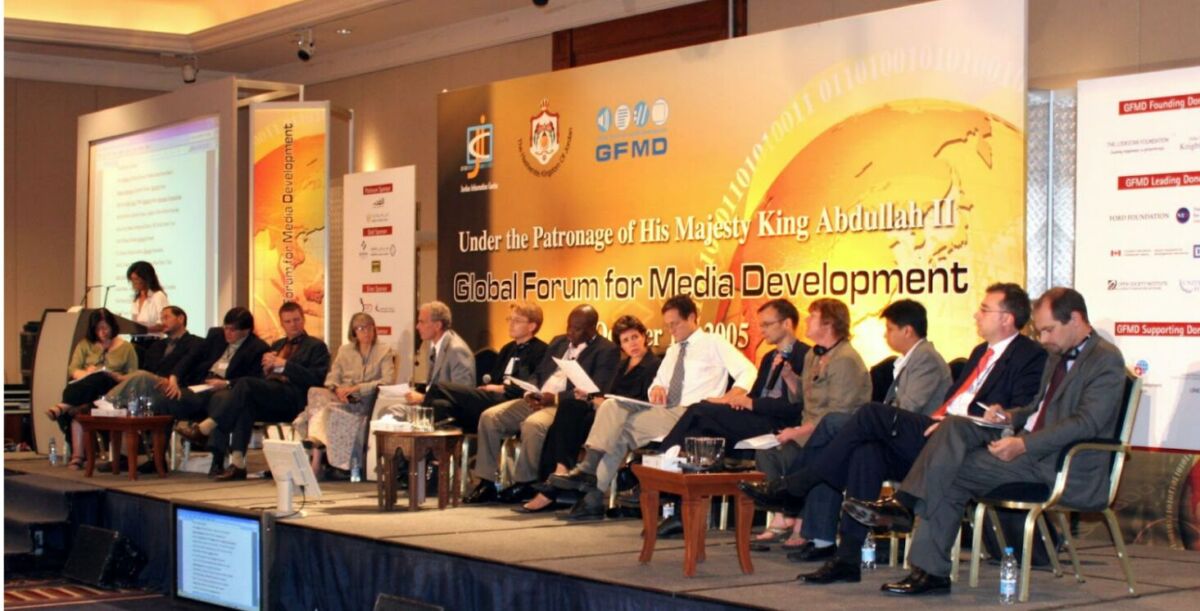
It has been 20 years since the photograph above was taken in Amman, Jordan. Familiar faces, dear friends, some of whom are sadly no longer with us, came together in 2005 to set up the Global Forum for Media Development. Looking at it now is quite emotional.
That first gathering of the GFMD community was marked not only by incredible expertise, good will, and ambition in the room, but also by an extraordinary testament to work that is being done to support journalism and media around the world. Media Matters: Perspectives on Advancing Governance and Development report captured the state of media freedom and media development at the time with remarkable clarity.
What is striking, and sobering, is how well that report still reads today. Not because the world has stood still, but because so many of the core challenges remain unresolved. Despite two decades of investment, collective action, and collaboration, media freedom has continued to decline across much of the world. The report cautioned even then that the level of funding for independent media amounted to “a drop of water in an ocean of demand”. Twenty years on, that diagnosis feels uncomfortably accurate.
So today rather than rehashing the same diagnosis and equally familiar call to action, I would like to try something different.
It is time to say out loud what many of us already think: we are trying to sustain journalism with systems and structures that were never designed to work together or, ultimately, to work for us.
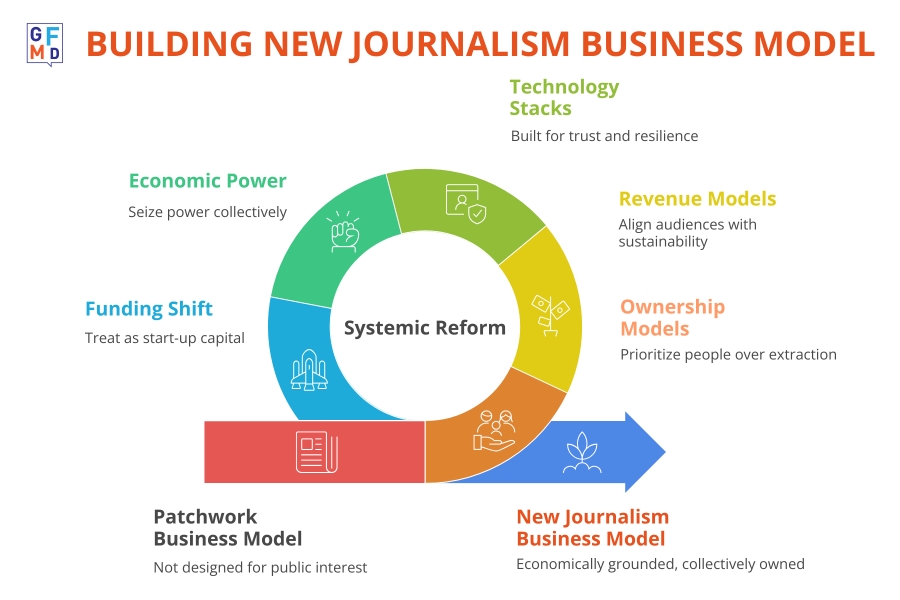
We have a patchwork business model, stitched together from collapsing advertising revenues, short-term grants, membership models that rarely cover costs, and side projects that often distract from core journalistic work. Philanthropy fills gaps it was never meant to fill, donors (often unintentionally) shape priorities and agendas, and survival depends on constantly chasing the next round of support. And we have a Frankenstein tech stack (or as our colleagues building civic tech call it, a Frankenstack), built on platforms designed for surveillance, extraction, and scale, not for public interest, trust, or community resilience.
None of this was designed with journalism as a public good in mind. It is the result of decades of adaptation, compromise, and improvisation inside political and economic systems that overwhelmingly favour corporate capitalism and extractive markets.
At the same time, unlike education, health, water supplies and other public goods, journalism is still expected to survive in rigged markets, while policy, regulation, and investment still favour large private actors. Expecting journalism to be funded as a public good at scale is a long-term policy project that’s likely to take decades. So in the meantime, we improvise. We collaborate. We volunteer. We form partnerships and coalitions that keep reporting alive against the odds.
This ingenuity is extraordinary, but it is not a sustainable strategy for the future. The truth is that journalism cannot exist without money. Commitment and collaboration alone cannot substitute a viable economic base.
Across other sectors, cooperative ownership, shared infrastructure, and collective action have enabled communities to pool resources, share risk, and build lasting economic power. These models treat essential services not as commodities to be stripped for profit, but as shared assets governed by those who depend on them. In the media, however, what is missing is not ideas, nor business models. It is the underlying legal frameworks and markets that are truly regulated and fair, investment vehicles, and infrastructure to support entrepreneurial models that remain largely absent.
We are trying to reform a system that was never designed for public-interest journalism in the first place. Instead of endlessly repairing Frankenstein’s monster, we should be asking a more radical question: what would a journalism and information system look like if we designed it from scratch – for our communities, our values, and our realities?
As Mariana Mazzucato argues in the Mission Economy, mission-oriented thinking demands a decisive break from fixing markets to creating them, from de-risking private actors to sharing risks collectively, and from picking winners to “picking the willing”. Ultimately, as Mazzucato makes clear, mission economies are not content with merely improving the rules of the game, but seek to change the game itself in order to drive transformative change, particularly in support of a green transition and the digitalisation of society. In the case of media, that means designing ownership models that prioritise people over extraction. Revenue models that align audiences with sustainability, not dependency. Technology stacks built for trust, resilience, and shared governance, not surveillance and monopolies. And crucially, it means seizing economic power collectively – because without economic power, editorial independence will always be conditional.
This also requires a shift in how we think about funding. The funding and investment that still exists should not be treated only as a revenue stream that keeps the lights on. They should primarily be treated as start-up capital: patient, risk-tolerant investment to build new markets, new institutions, and new forms of ownership that can stand on their own. We need grants and investments to help us build the house and the environment that sustains it, not pay the rent forever.
If journalism is truly to function as a public good, then we must start building it as one – deliberately, collectively, and at the level of systems, not projects. That is not a call for abandonment of what exists, but a recognition that incremental fixes will not be enough.
The next phase of media development is about having the courage to design and build something new.
This is the challenge – and the opportunity – as GFMD enters its next chapter: not only to defend media freedom, but to help catalyse the creation of a new journalism ecosystem that is economically grounded, collectively owned, and fit for just and inclusive societies.
Throughout the year, GFMD has taken important steps to strengthen our community’s ability to respond to these realities. We extend our deepest gratitude to Zoe Titus and the outgoing Steering and Executive Committees for their dedication, insight, and steadfast leadership over the past four years. We also welcomed a newly elected Steering Committee and Executive Committee, bringing regional diversity and renewed commitment to our shared mission. Together, we have begun developing a new four-year strategy — a roadmap aimed at reinforcing independent media as a public good, strengthening evidence-based approaches to media development, and supporting practitioners working in some of the world’s most challenging environments.
For our team at GFMD, like for many of you, this year has been one of the most testing ones. We lost colleagues. A lot of you have lost jobs. Many members have closed or are facing closure. Through it all, GFMD’s strength has remained exactly where it has always been: in its members, partners, supporters, and the people on the ground who continue, often under extraordinary circumstances, to keep journalism alive and communities informed.
As Jesper Højberg noted in his speech to mark GFMD’s 20th anniversary at the 18th annual ARIJ Forum:
“In the challenging times we are living in, it matters how we decide to come together. It matters how we spend our time, and it matters how we, with increasingly limited resources, focus on what is most important, and what is most likely to yield results.”
These words capture the spirit that has guided our work throughout this year.
To everyone who was with us over the past 20 years: thank you! To everyone who contributed in 2025: thank you! Your dedication, creativity, and solidarity are the heartbeat of this network. Your work sustains democratic values, strengthens public-interest media, and ensures that independent media ecosystems can not only survive but grow more resilient.
We invite you to continue this journey with us: by staying engaged in the network, sharing knowledge and experience, contributing to collective advocacy, and supporting GFMD’s work to advance independent media as a public good worldwide.
With gratitude and hope,
Mira Milosevic, Executive Director